

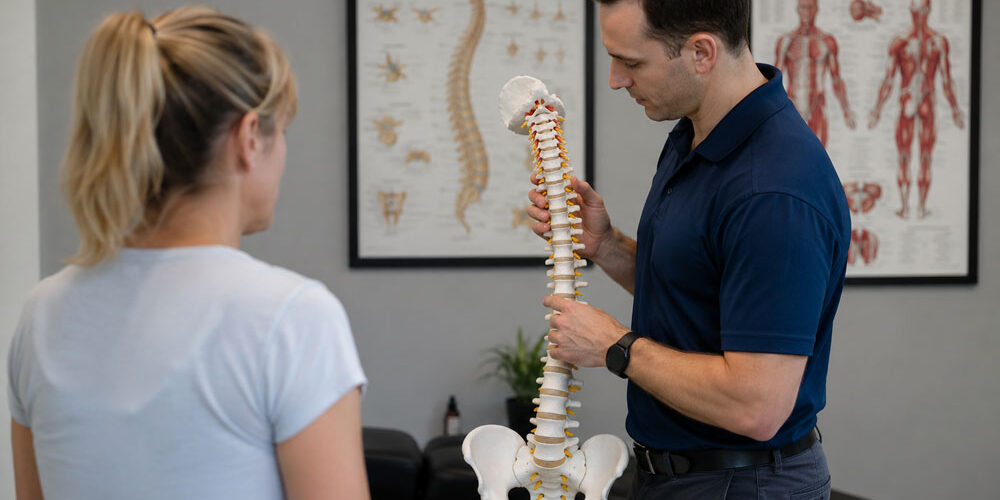
Many adults with scoliosis are not looking for a miracle promise. They want something more practical.
They want to know why their back feels tight after sitting. Why one hip feels different from the other. Why the same area keeps getting sore. Why posture feels harder to control than it used to. And most of all, they want to know if there is a way to move through the day with less discomfort.
Chiropractic care cannot promise to straighten a scoliosis curve or reverse the structure of the spine. That would not be a fair or responsible claim. But for some adults, chiropractic care may help with the way the body responds to scoliosis: stiffness, muscle tension, joint restriction, posture stress, and movement-related discomfort.
At Ten Oaks Health and Wellness in Glenelg, MD, care for adults with scoliosis is focused on comfort, mobility, posture support, and realistic daily function. The goal is to understand how scoliosis is affecting the person in front of us, not just the curve on paper.
Why Scoliosis Can Feel Different in Adulthood
Scoliosis is often discovered during childhood or the teenage years, but many people continue to feel its effects as adults. Some adults were diagnosed earlier in life and only notice symptoms years later. Others develop changes in the spine over time, sometimes referred to as adult degenerative scoliosis.
Adult scoliosis may be influenced by several factors, including age-related changes, disc wear, joint stiffness, muscle imbalance, old injuries, posture habits, and the physical demands of daily life.
That is why two adults with scoliosis can feel completely different. One person may have mild stiffness. Another may have back pain, hip discomfort, leg symptoms, neck tension, or difficulty standing for long periods.
The curve matters, but symptoms often come from how the body compensates around that curve.
Can Chiropractic Care Help Adults with Scoliosis?
Chiropractic care may help some adults with scoliosis by addressing restricted movement, joint stress, muscle tension, and posture-related strain. It is not a cure for scoliosis, and it should not be presented as a way to permanently correct the spinal curve.
For adults, the value of chiropractic care is often more practical:
- Helping stiff areas move more comfortably
- Reducing unnecessary stress on irritated joints
- Supporting better movement patterns
- Helping manage muscle tightness around the back, hips, neck, or shoulders
- Improving awareness of posture and body mechanics
- Supporting comfort during sitting, standing, walking, and daily tasks
For a deeper overview of this topic, Ten Oaks Health and Wellness has a full guide on scoliosis chiropractic care in Glenelg, MD.
What Adult Scoliosis Symptoms May Respond to Supportive Care?
Adults with scoliosis may seek care for many different reasons. Some symptoms are constant. Others show up only after certain activities, such as sitting at a desk, driving, working out, gardening, standing at work, or walking for longer periods.
A chiropractic evaluation may be helpful when scoliosis is associated with:
- Lower back pain
- Upper back tightness
- Neck pain
- Muscle tension on one side of the body
- Hip discomfort
- Uneven shoulder or hip position
- Stiffness after sitting
- Discomfort after standing
- Reduced mobility
- Posture changes
- Fatigue in the back muscles
- Difficulty staying active comfortably
These symptoms do not always mean scoliosis is getting worse. Sometimes they are related to compensation, tension, joint irritation, or movement habits. That is why an evaluation matters.
What Chiropractic Care Cannot Promise
This part matters.
Adults with scoliosis should be cautious with anyone who promises to “fix” scoliosis, fully straighten the spine, or reverse the curve with a simple treatment plan. Scoliosis is more complex than that.
Chiropractic care cannot guarantee:
- Permanent correction of the spinal curve
- Reversal of scoliosis
- Avoidance of all future symptoms
- The same outcome for every patient
- Replacement for medical monitoring when needed
Responsible care begins with honest expectations. For many adults, the goal is not to chase a perfect spine. The goal is to move better, feel less restricted, reduce recurring tension, and understand how to support the body more effectively.
Why Adults with Scoliosis Often Feel Muscle Tightness
When the spine curves or rotates, muscles may not work evenly from side to side. Some muscles may feel overworked. Others may feel weaker or less active. Over time, this can create a pattern of tightness, fatigue, or irritation.
One side of the lower back may feel more tense. The hips may feel uneven. The shoulders may round or rotate differently. The neck may tighten because the upper body is trying to compensate for what is happening below.
This is one reason a whole-body view is helpful. The painful area is not always the only area that needs attention.
At Ten Oaks Health and Wellness, care may include chiropractic care, soft tissue work, posture guidance, movement support, and recommendations that fit the patient’s daily routine.
How Corrective Exercise May Support Adult Scoliosis
For many adults with scoliosis, movement is part of the plan. Not aggressive exercise. Not random stretches copied from the internet. The right exercises should match the person’s body, symptoms, strength, and comfort level.
Physical therapy and corrective exercise may help support:
- Core stability
- Hip strength
- Posture awareness
- Spinal mobility
- Balance and control
- Better movement habits
- Comfort during daily activities
The goal is not to force the body into a rigid position. The goal is to help the body become more stable, more aware, and more comfortable with movement.
How Massage Therapy and Active Release May Help
Adults with scoliosis often deal with soft tissue tension. Muscles, fascia, tendons, and surrounding tissues may become irritated from years of compensation.
Massage therapy may help reduce general muscle tension and soreness. This can be useful for patients who feel tightness through the back, hips, shoulders, or neck.
Active release technique may be helpful when soft tissue restrictions are affecting movement. For some patients, this may support better comfort through the hips, legs, lower back, shoulders, or neck.
These services may be used alone or alongside chiropractic care, depending on the evaluation.
When Should an Adult with Scoliosis Be Evaluated?
You do not have to wait until pain becomes severe. A consultation can be helpful when symptoms begin affecting your routine or limiting what you feel comfortable doing.
Consider scheduling an evaluation if you notice:
- Back pain that keeps returning
- Neck or shoulder tension that does not fully settle
- Hip discomfort or uneven pressure
- Stiffness after sitting or standing
- Reduced ability to exercise comfortably
- Posture changes that concern you
- Muscle tightness on one side of the body
- Pain that changes how you walk, work, sleep, or move
Some symptoms need medical attention sooner. If you have severe pain, progressive weakness, numbness that is getting worse, loss of coordination, fever, unexplained weight loss, or changes in bladder or bowel control, seek medical evaluation promptly.
Adult Scoliosis Care Near Ellicott City and Howard County
Ten Oaks Health and Wellness is located in Glenelg, MD and serves patients from Ellicott City, Clarksville, West Friendship, Columbia, Scaggsville, and the surrounding Howard County area.
For adults with scoliosis, convenience matters. Care is easier to maintain when the office is close enough to fit into real life. Work schedules, family responsibilities, exercise routines, and daily stress all affect whether someone can stay consistent.
Patients visit Ten Oaks Health and Wellness for help with scoliosis-related back pain, stiffness, posture concerns, muscle tension, mobility issues, and whole-body wellness support.
What to Expect at Ten Oaks Health and Wellness
A scoliosis-related visit should start with listening. Your provider should understand your history, your symptoms, your daily routine, and what you want to be able to do more comfortably.
The evaluation may include posture assessment, movement testing, range of motion, discussion of previous imaging if available, and a closer look at how your body is compensating.
From there, care may include chiropractic adjustments, corrective exercise, soft tissue therapy, posture guidance, or another supportive approach. The plan should be explained clearly, with realistic expectations.
If you are an adult with scoliosis and you want to better understand your options, you can contact Ten Oaks Health and Wellness to schedule a consultation.
FAQ
Can chiropractic care help adult scoliosis?
Chiropractic care may help some adults with scoliosis-related symptoms such as back pain, stiffness, muscle tension, posture stress, and reduced mobility. It should not be presented as a guaranteed way to reverse or correct the spinal curve.
Can a chiropractor straighten scoliosis in adults?
A chiropractor should not promise to straighten scoliosis in adults. The focus of care is usually on symptom support, mobility, muscle tension, posture awareness, and helping the patient move more comfortably.
Why does scoliosis cause back pain in adults?
Adult scoliosis may contribute to back pain because the spine, joints, muscles, and hips may compensate unevenly. This can create stiffness, muscle fatigue, joint irritation, or discomfort after sitting, standing, walking, or exercising.
Is chiropractic care safe for adults with scoliosis?
Chiropractic care may be appropriate for some adults with scoliosis when it is based on a careful evaluation and realistic goals. Safety depends on the patient’s symptoms, health history, curve severity, age, and whether additional medical evaluation is needed.
Do adults with scoliosis need exercises?
Some adults with scoliosis benefit from corrective exercise or physical therapy support. Exercises may help with strength, stability, posture awareness, mobility, and comfort during daily movement.
When should I see a chiropractor for scoliosis pain?
You may want to schedule an evaluation if scoliosis-related back pain, neck pain, hip discomfort, stiffness, or posture changes are affecting your daily routine, movement, sleep, work, or ability to stay active.