

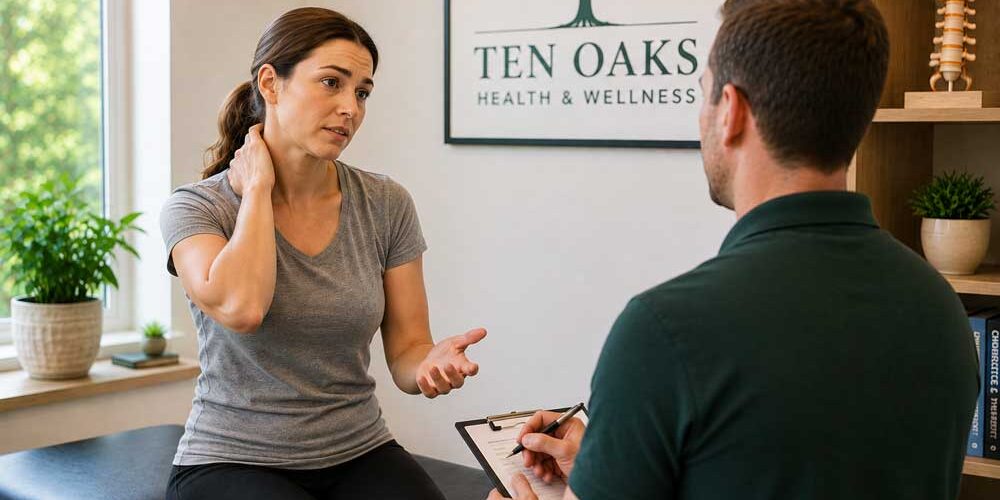
Neck and back pain do not always start with one obvious injury. Sometimes discomfort builds slowly. A little stiffness after work becomes a regular pattern. Shoulder tension starts showing up every afternoon. The lower back feels tight after driving or sitting. Headaches appear when the neck and upper back feel tense.
For many people, the cause is not one single movement. It is the way posture, stress and daily habits add up over time.
At Ten Oaks Health and Wellness in Glenelg, MD, patients often describe this kind of gradual discomfort. They may not remember doing anything specific to cause the pain. They simply notice that their body feels tighter, more tired or less comfortable than it used to.
This article explains how posture, stress and everyday routines may contribute to neck and back pain, and when it may be helpful to have those patterns evaluated.
Neck and Back Pain Often Build Over Time
Some pain starts suddenly after a fall, accident or clear injury. But many cases of neck and back discomfort develop gradually.
A person may spend long hours sitting, driving, working at a computer, looking down at a phone or carrying stress in the shoulders. At first, the body adapts. Then, over time, certain muscles become overworked, joints become stiff, posture becomes harder to maintain, and movement starts to feel less natural.
This does not mean posture is the only cause of pain. It also does not mean every ache is serious. But daily habits can place repeated stress on the same areas of the body, especially the neck, shoulders, upper back, lower back and hips.
How Posture Can Affect Neck and Back Pain
Posture is not about sitting perfectly straight all day. The body is designed to move. A healthy posture is not one fixed position, but the ability to change positions comfortably without placing too much stress on one area.
Problems often begin when the body stays in the same pattern for too long.
Common posture patterns that may contribute to discomfort include:
- Forward head position from screen use
- Rounded shoulders during desk work
- Slouching in a chair for long periods
- Leaning to one side while sitting
- Standing with uneven weight on one leg
- Looking down at a phone or tablet often
- Sitting with little lower back support
- Holding the shoulders up during stress
These positions are not always harmful by themselves. The issue is repetition. If the same posture is held for hours every day, the body may begin to adapt around it.
Why the Neck Often Feels It First
The neck is sensitive to posture and stress because it supports the head and connects closely with the shoulders and upper back.
When the head drifts forward toward a screen, the muscles at the back of the neck and upper shoulders may have to work harder. Over time, this can contribute to stiffness, tightness, reduced movement and sometimes headaches.
Neck pain may be influenced by:
- Computer or laptop work
- Phone use
- Driving posture
- Stress-related shoulder tension
- Upper back stiffness
- Poor sleep position
- Reduced movement during the day
When neck discomfort keeps returning, it may help to look at the full pattern rather than only the painful area.
How Daily Sitting Can Affect the Lower Back
Sitting is not automatically bad. The body can handle sitting. The problem is usually sitting for too long without enough movement or support.
Long periods of sitting can affect the lower back, hips and pelvis. Some people feel lower back stiffness when standing up. Others feel hip tightness, glute discomfort, or pain that returns after driving or working at a desk.
Common sitting-related patterns include:
- Lower back stiffness after work
- Hip tightness when standing
- Back pain after driving
- Discomfort that improves with movement
- Slouching as the day goes on
- Fatigue in the lower back muscles
If lower back pain keeps returning after sitting or driving, it may involve spinal movement, hip mobility, posture habits, core support or muscle guarding.
Stress Can Change How the Body Holds Tension
Stress does not only affect mood. It can also affect how the body feels.
Many people carry stress in the neck, shoulders, jaw, upper back or lower back. The muscles may stay slightly contracted during the day without the person noticing. Over time, this can create tightness, soreness or fatigue.
Stress-related muscle tension can feel like:
- Shoulders staying high or tense
- A tight band across the upper back
- Neck stiffness by the end of the day
- Jaw tension or headaches
- Lower back tightness after a stressful week
- Difficulty relaxing even when resting
This does not mean the pain is imaginary. It means the nervous system, muscles and daily stress patterns are connected.
Why Pain May Keep Returning
Many people feel better after rest, stretching, massage or movement, but then the same pain returns. This can happen when the underlying habit or stress pattern has not changed.
For example, a person may stretch the neck each morning but continue looking down at a laptop for hours. Another person may feel better after massage, but still hold stress in the shoulders every workday. Someone with lower back stiffness may take breaks for a few days, then go back to long sitting without movement.
The body often returns to the same pattern unless something helps change the way it is moving, working or recovering.
When Chiropractic Care May Be Helpful
Chiropractic care may be helpful for some patients when neck or back pain is connected to joint restriction, spinal mechanics, posture stress or movement patterns.
A chiropractic evaluation may look at how the spine, joints and surrounding muscles are functioning together. The goal is not simply to focus on the painful area, but to understand what may be adding stress to that area.
For some patients, chiropractic care may be part of a broader plan that also includes massage therapy, soft tissue work, corrective exercise, posture support or habit changes.
When Massage Therapy May Help
Massage therapy may help when neck or back discomfort is connected to muscle tension, soreness, stress-related tightness or soft tissue discomfort.
Massage may be especially useful when the body feels guarded, overworked or unable to relax. It can support muscle comfort and help reduce tension in areas that are carrying repeated stress.
If tightness keeps returning, massage may still be valuable, but it may also be helpful to look at posture, movement habits, stress, joint mobility and strength.
When Active Release Technique May Be Considered
Active Release Technique may be considered when soft tissue restrictions are affecting movement or contributing to tightness that keeps coming back.
Soft tissue restrictions can involve muscles, tendons, ligaments, fascia or nerves. These restrictions may develop after repetitive strain, overuse, injury or long-term compensation.
Active Release is usually more specific than general massage and may be used when a particular area feels restricted, irritated or movement-related.
Why Corrective Exercise Can Matter
Hands-on care can help, but daily movement patterns also matter. If certain muscles are weak, tired or not supporting the body well, other areas may overwork to compensate.
Physical therapy and corrective exercise may help support better strength, stability, mobility and movement control.
Corrective exercise may focus on:
- Core stability
- Hip strength
- Upper back strength
- Shoulder control
- Posture awareness
- Mobility
- Balance and coordination
- Reducing compensation patterns
The goal is not to force a perfect posture. The goal is to help the body handle daily life with less strain.
How Posture Support Can Help Patients Understand the Pattern
Spinal posture and correction may help patients better understand how alignment, posture habits, muscle endurance and movement patterns may be contributing to discomfort.
This kind of care is not about blaming posture for every problem. It is about helping patients see how the body is adapting to daily stress and whether those adaptations are affecting pain, stiffness or movement comfort.
For some patients, simply understanding the pattern can be helpful. It gives them clearer reasons for why symptoms keep returning and what changes may support better function.
Simple Daily Habits That May Help
Small changes can reduce the repeated stress that builds during the day. These habits do not replace professional care when symptoms are persistent, but they may support better comfort.
- Change positions every 30 to 45 minutes
- Take short walking breaks during long work periods
- Raise screens closer to eye level when possible
- Keep the shoulders relaxed during computer work
- Avoid holding the phone between the shoulder and ear
- Use supportive sitting instead of collapsing into the chair
- Move gently after long drives
- Pay attention to stress-related jaw or shoulder tension
- Include light mobility work during the day
The best posture is often the next posture. Regular movement is usually more helpful than trying to hold one perfect position all day.
When Neck or Back Pain Should Be Checked
Neck or back pain may be worth evaluating when it keeps returning, limits movement, affects sleep, interferes with work or changes the way you move.
You may want to schedule a visit if you notice:
- Neck or back pain that keeps coming back
- Muscle tension that returns after stretching or massage
- Headaches with neck or shoulder tightness
- Lower back stiffness after sitting or driving
- Posture changes that feel harder to correct
- Reduced mobility or flexibility
- Pain that affects work, sleep or activity
Seek medical care promptly if pain is severe, worsening, follows major trauma, or is associated with progressive weakness, significant numbness, fever, unexplained weight loss, loss of balance or changes in bladder or bowel control.
Neck and Back Pain Care Near Glenelg and Surrounding Communities
Ten Oaks Health and Wellness is located in Glenelg, MD and serves patients from nearby communities throughout Howard County and surrounding areas.
Patients looking for a chiropractor near West Friendship, MD, a chiropractor near Clarksville, MD, a chiropractor near Dayton, MD, a chiropractor near Woodbine, MD, a chiropractor near Lisbon, MD or a chiropractor near Sykesville, MD can visit the nearby Glenelg office for chiropractic and wellness support.
Care may include chiropractic care, massage therapy, Active Release Technique, corrective exercise, posture support or another recommendation based on the patient’s needs.
Start with Understanding Your Daily Pattern
If neck or back pain keeps showing up, it may help to look beyond the painful area and understand the daily pattern behind it.
At Ten Oaks Health and Wellness, care starts with listening and evaluation. The goal is to help patients understand what may be contributing to their symptoms and which type of support may make sense.
You can explore all wellness services in Glenelg, MD, read more about what to expect at your first visit, or contact Ten Oaks Health and Wellness to ask a question or schedule a visit.
FAQ
Can posture cause neck and back pain?
Posture may contribute to neck and back pain in some people, especially when combined with long sitting, screen use, muscle fatigue, stress or reduced movement.
Can stress cause muscle tension in the neck and back?
Stress can contribute to muscle guarding and tension, especially in the neck, shoulders, jaw, upper back and lower back. This can make discomfort more noticeable over time.
Why does my neck hurt after working at a computer?
Neck pain after computer work may be connected to forward head posture, screen height, shoulder tension, upper back stiffness, reduced movement or stress-related muscle guarding.
Why does my lower back hurt after sitting?
Lower back pain after sitting may involve posture, hip stiffness, spinal mechanics, muscle fatigue, core support or staying in one position for too long.
Can chiropractic care help posture-related pain?
Chiropractic care may help some patients when posture-related pain is connected to joint restriction, spinal mechanics or movement patterns. The right approach depends on the evaluation.
When should I get neck or back pain checked?
You may want to get neck or back pain checked if it keeps returning, limits movement, affects sleep or work, or is associated with headaches, stiffness, weakness, numbness or worsening symptoms.