

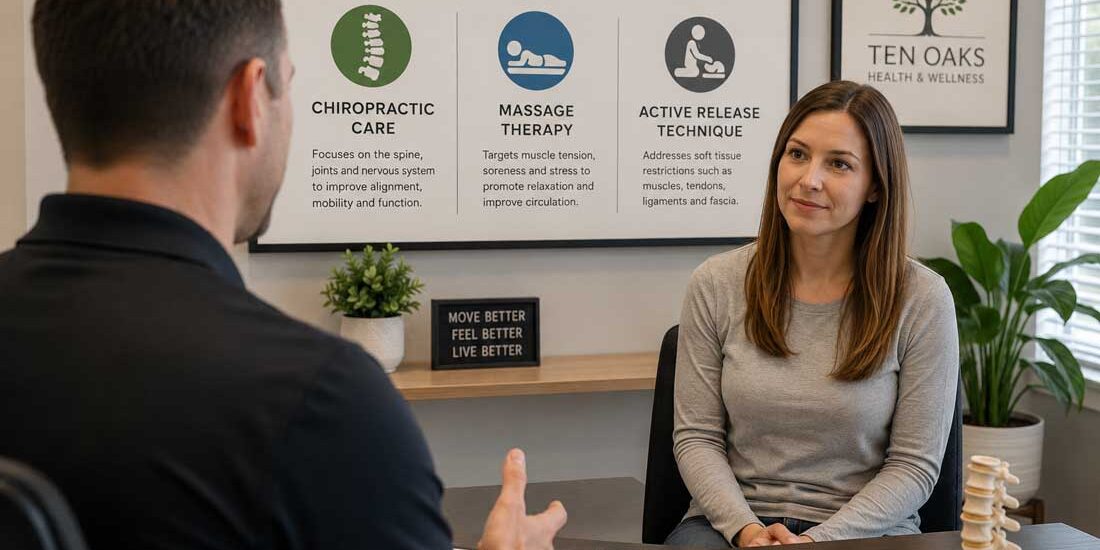
When something hurts, it is not always easy to know where to start. Should you see a chiropractor? Schedule massage therapy? Ask about Active Release Technique? Try exercises? Rest and wait?
Most people do not think in terms of services. They think in terms of symptoms. A stiff neck. A tight lower back. Shoulder tension. Hip discomfort. Headaches. A sore muscle that keeps coming back. Pain after sitting, driving or working at a desk.
At Ten Oaks Health and Wellness in Glenelg, MD, patients often ask which type of care makes the most sense for what they are feeling. The answer depends on the source of the discomfort, how the body is moving, how long symptoms have been present, and whether the issue involves joints, muscles, soft tissue, posture, movement patterns or a combination of factors.
This guide explains the difference between chiropractic care, massage therapy and Active Release Technique in simple terms, so you can better understand which option may fit your situation.
Start with the Symptom, Not the Service
It is natural to search for a service first. Many people type “chiropractor near me” or “massage therapy near me” because they know they need help, but they are not sure what kind.
A better starting point is to look at what your body is telling you.
Ask yourself:
- Is the pain sharp, dull, tight, sore or burning?
- Does it feel more like joint stiffness or muscle tension?
- Does it get worse after sitting, standing, driving or exercise?
- Does stretching help, or does the tightness come back quickly?
- Does the pain travel into the arm, hip or leg?
- Does it feel connected to posture or desk work?
- Did it start after an injury, accident or repeated movement?
- Is the problem new, or has it been building for months?
These details help guide the next step. The right care should be based on the person, not only the name of the service.
What Chiropractic Care Focuses On
Chiropractic care in Glenelg, MD focuses on how the spine, joints and nervous system are functioning. It may be helpful when pain is connected to joint restriction, spinal mechanics, posture stress, movement patterns or mobility issues.
Many patients consider chiropractic care when they have symptoms such as:
- Back pain
- Neck pain
- Headaches connected with neck tension
- Lower back stiffness
- Posture-related discomfort
- Pain after sitting or driving
- Reduced spinal mobility
- Discomfort that keeps returning with movement
Chiropractic care is not simply about “cracking the back.” A good evaluation looks at how the body moves, where stress is building, and whether joint restriction may be contributing to the symptoms.
For some patients, chiropractic care may be the main service. For others, it works best alongside soft tissue care, corrective exercise, massage therapy or posture support.
When Chiropractic Care May Be a Good Starting Point
Chiropractic care may be a good starting point when symptoms feel connected to movement, posture or joint stiffness.
For example, if your lower back feels locked after sitting, if your neck feels restricted when turning, or if pain keeps returning in the same spinal area, a chiropractic evaluation may help identify whether joint motion or spinal mechanics are part of the problem.
It may also be a good starting point when symptoms involve more than one area. Back pain with hip tightness, neck pain with headaches, or posture issues with muscle tension often require a broader look at how the body is working together.
Chiropractic care should always be based on evaluation and realistic expectations. It is not a one-size-fits-all answer for every pain condition.
What Massage Therapy Focuses On
Massage therapy focuses on muscles and soft tissues. It may help patients who feel tight, sore, stressed, guarded or physically overworked.
Many people choose massage therapy when they are dealing with:
- Muscle tension
- Stress-related tightness
- Neck and shoulder soreness
- Lower back muscle tightness
- General stiffness
- Soreness after activity
- Recovery support
- A need for relaxation and body reset
Massage therapy can be calming, but it can also be therapeutic. The goal may be relaxation, muscle relief, improved comfort, or support for areas that feel overworked.
At Ten Oaks Health and Wellness, massage therapy is part of a whole-body approach. It may be used by itself or alongside chiropractic care, Active Release or corrective exercise depending on the patient’s needs.
When Massage Therapy May Be the Better Fit
Massage therapy may be a better fit when the main issue feels muscular, stress-related or tension-based.
For example, massage therapy may be helpful if your shoulders feel tight after computer work, your lower back feels sore after a long week, or your body feels physically tense from stress.
It may also be useful when you feel like your body needs help settling down. Some people hold tension for so long that relaxation itself becomes difficult. Massage therapy can give the body time to release unnecessary guarding.
If pain is sharp, radiating, worsening, linked with weakness or numbness, or caused by a recent injury, an evaluation may be needed before deciding whether massage is appropriate.
What Active Release Technique Focuses On
Active Release Technique, often called ART, is a more specific soft tissue approach. It focuses on muscles, tendons, ligaments, fascia and nerves that may be restricted, irritated or not moving well.
Active Release may be considered when symptoms are connected to soft tissue restriction, repetitive strain, sports activity, overuse or movement-related discomfort.
Patients may ask about Active Release for concerns such as:
- Soft tissue tightness that keeps returning
- Sciatica-like discomfort
- Shoulder pain
- Back pain with hip or glute tightness
- Neck tension from repetitive posture
- Sports-related soft tissue issues
- Repetitive strain symptoms
- Tightness that does not respond well to stretching alone
Active Release is usually more targeted than general massage therapy. It often involves manual contact with a specific tissue while the patient moves through a guided motion.
Active Release vs Massage Therapy
Massage therapy and Active Release both work with soft tissues, but they are not the same.
Massage therapy may be broader. It can focus on relaxation, muscle tension, soreness, recovery and general soft tissue comfort.
Active Release is usually more specific. It is often used when a particular muscle, tendon, fascia area or movement pattern seems restricted or irritated. It may be more focused on how the tissue moves during an activity.
A simple way to think about it:
- Massage therapy may be helpful when the body feels tight, sore, stressed or overworked.
- Active Release may be helpful when a specific soft tissue restriction is affecting movement or keeps coming back.
Some patients benefit from one. Some benefit from both at different times. The right choice depends on the evaluation.
Chiropractic Care vs Massage Therapy
Chiropractic care and massage therapy can support different parts of the same problem.
Chiropractic care is often focused on joint mobility, spinal mechanics and movement patterns. Massage therapy is often focused on muscle tension, soreness and soft tissue comfort.
For example, a patient with neck pain may have restricted movement in the neck and upper back, plus tight muscles around the shoulders. Chiropractic care may help address the joint and movement side of the problem, while massage therapy may help reduce the muscle tension around it.
A patient with lower back pain may have spinal stiffness, hip tightness and guarded muscles. In that case, a combined approach may make more sense than choosing only one service.
The best care plan depends on what is causing the symptoms, not only where the pain is felt.
Where Corrective Exercise Fits In
Hands-on care can help, but lasting improvement often depends on what the body does between visits.
Physical therapy and corrective exercise may help when pain or tightness is connected to weakness, poor stability, limited mobility, posture habits or movement patterns.
Corrective exercise may support:
- Core stability
- Hip strength
- Posture awareness
- Shoulder control
- Mobility
- Balance and coordination
- Better movement during daily activities
This matters because symptoms often return when the same movement pattern keeps repeating. If a muscle is tight because it is overworking, stretching or massage may help temporarily, but strengthening and better movement control may be needed for longer-term support.
Can These Services Be Combined?
Yes. In many cases, services can complement each other.
For example:
- Chiropractic care may support joint mobility while massage therapy addresses muscle tension.
- Active Release may help specific soft tissue restrictions while corrective exercise supports better movement patterns.
- Massage therapy may help the body relax while posture care addresses daily habits that keep tension returning.
- Corrective exercise may help maintain progress between hands-on visits.
Not every patient needs every service. Some people do well with one clear approach. Others need a combined plan because the problem involves more than one layer.
You can review the full range of wellness services in Glenelg, MD offered at Ten Oaks Health and Wellness.
How to Know Which Option to Choose First
If you are not sure where to begin, that is normal. You do not need to diagnose yourself before scheduling a visit.
A helpful way to think about it is:
- Choose chiropractic care if pain feels connected to joint stiffness, spinal movement, posture or recurring back and neck discomfort.
- Choose massage therapy if the main issue feels like muscle tension, soreness, stress or general tightness.
- Choose Active Release if the problem feels specific, movement-related, repetitive or like a soft tissue restriction that keeps returning.
- Choose corrective exercise if symptoms are tied to weakness, stability, posture habits or movement patterns.
If symptoms are severe, worsening, radiating, associated with numbness or weakness, or started after trauma, a more careful evaluation is especially important.
When to Schedule an Evaluation
You may want to schedule an evaluation if discomfort is affecting your normal routine or if the same problem keeps returning.
A visit may be helpful if you notice:
- Back pain or neck pain that keeps coming back
- Muscle tension that does not improve for long
- Headaches connected with neck or shoulder tightness
- Hip, glute or leg discomfort
- Reduced movement or flexibility
- Soft tissue pain after repetitive work or exercise
- Posture-related discomfort
- Pain after sitting, driving or standing
Seek medical care promptly if pain is severe, follows major trauma, causes progressive weakness, includes major numbness, or is associated with fever, unexplained weight loss, loss of balance or changes in bladder or bowel control.
Care Near Ellicott City and Howard County
Ten Oaks Health and Wellness is located in Glenelg, MD and serves patients from Ellicott City, Clarksville, West Friendship, Columbia, Scaggsville and the surrounding Howard County area.
Patients visit the office for help with back pain, neck pain, headaches, posture concerns, muscle tension, soft tissue restrictions, mobility issues and recovery support.
If you are unsure whether chiropractic care, massage therapy, Active Release or corrective exercise is the right place to start, a consultation can help you make that decision with more confidence.
For patients in nearby West Friendship, Ten Oaks Health and Wellness offers a convenient Glenelg location for chiropractic and wellness support. If you are comparing options and looking for a chiropractor near West Friendship, MD, our team can help you understand whether chiropractic care, massage therapy, Active Release or corrective exercise may be a good starting point.
Start with a Conversation
The right care starts with listening. Your symptoms, lifestyle, work habits, activity level and goals all matter.
At Ten Oaks Health and Wellness, the goal is to help patients understand what may be contributing to their discomfort and which services may support better movement, comfort and wellness.
If you have questions before scheduling, you can read more about what to expect at your first visit.
To ask a question or schedule a visit, you can contact Ten Oaks Health and Wellness.
FAQ
Should I see a chiropractor or get a massage?
It depends on your symptoms. Chiropractic care may be a better starting point when pain is connected to joint stiffness, spinal movement, posture or recurring back and neck discomfort. Massage therapy may be more helpful when the main concern is muscle tension, soreness, stress or general tightness.
Is Active Release the same as massage therapy?
No. Active Release and massage therapy both work with soft tissues, but Active Release is usually more specific and often combines manual contact with guided movement. Massage therapy may be broader and may focus on muscle tension, soreness, relaxation or recovery support.
Can chiropractic care and massage therapy be combined?
Yes. Some patients benefit from combining chiropractic care and massage therapy, especially when both joint restriction and muscle tension are contributing to symptoms.
When is Active Release a good option?
Active Release may be considered when symptoms are related to soft tissue restrictions, repetitive strain, sports activity, sciatica-like discomfort, shoulder pain, or tightness that keeps returning despite stretching.
Do I need corrective exercise too?
Corrective exercise may be helpful when symptoms are connected to weakness, poor stability, posture habits or movement patterns. It can support longer-term improvement by helping the body move with better control.
What if I do not know which service I need?
You do not need to know exactly which service you need before reaching out. A consultation can help determine whether chiropractic care, massage therapy, Active Release, corrective exercise or another service may be appropriate for your situation.